Professional development works best when learning, recording, oversight, and industry standards all work together.
PD able was designed as a connected ecosystem where professionals, employers, education providers, and system administrators interact within a single professional development environment.
Rather than operating as isolated tools or spreadsheets, PD able creates a structured system where learning activity, professional records, and organisational oversight all feed into each other, creating a continuous improvement cycle.
This ecosystem helps organisations track development, helps professionals manage their growth, and allows learning providers to connect their training directly into the professional development environment.
The four key roles in the PD able ecosystem
At the centre of the PD able system are four connected roles.
PD System Owner (Administrator)
The PD System Owner manages the overall structure of the professional development system.
- Professional development cycles
- Competency frameworks
- Categories of learning
- System rules and requirements
System owners are often industry bodies, associations, training organisations, or central administrators responsible for defining how professional development should operate.
Employers
Employers manage the professional development of their teams within the system.
- Monitor staff professional development records
- Review plans and goals
- Track learning hours and competencies
- Allocate or manage professional development budgets
Employers gain visibility over team development while staff retain ownership of their own professional learning records.
Professionals
Professionals are the individuals actively building their professional development record.
- Teachers
- Trainers
- Nurses
- Accountants
- Engineers
- Any professional required to maintain ongoing learning
Professionals use PD able to record activities, manage goals, and track their development over time.
Education Providers
Education providers supply the learning experiences that drive professional development.
- Training organisations
- Course providers
- Industry educators
- Workshops and certification programmes
Learning providers can connect their training offerings into the PD able ecosystem, making it easier for professionals and employers to track completed learning.
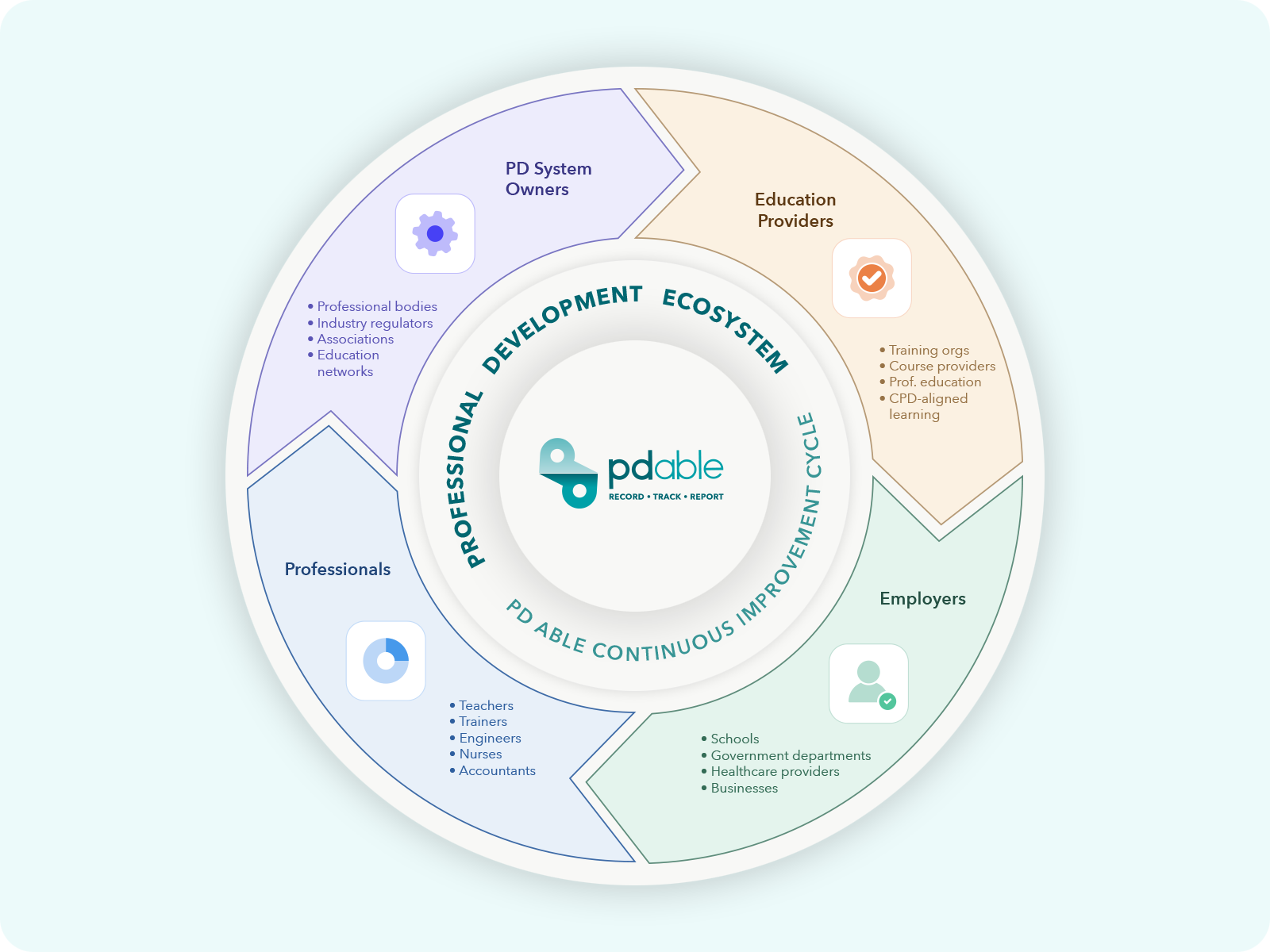
A connected professional development environment
When these roles work together, PD able becomes more than just a record-keeping tool.
Learning providers deliver training. Professionals record and reflect on their learning. Employers support and monitor development across their teams. System owners maintain the standards that guide the entire ecosystem.
This creates a continuous cycle of learning, recording, reviewing, and improving professional capability.
Flexible structures for multi-organisation systems
One of the strengths of PD able is its ability to support shared systems across multiple organisations.
For example, a cluster of schools may operate within a single professional development system managed by a central administrator.
- The central organisation acts as the system owner
- Each school operates as an employer
- Each school manages only its own staff
- Data remains separated between organisations
This allows large networks, associations, or industry groups to operate under one shared professional development framework while maintaining organisational independence.
Flexible payment options
PD able also allows flexible funding structures.
- The system owner may cover all users
- Individual organisations may pay for their own staff
This flexibility makes PD able suitable for industry associations, professional bodies, school networks, training organisations, and multi-organisation professional systems.
A scalable professional development ecosystem
By connecting professionals, employers, educators, and administrators, PD able creates a scalable system where professional development can grow and evolve over time.
As more learning activities, organisations, and professionals participate, the ecosystem becomes stronger, helping individuals develop their skills while supporting organisations in building capable and confident teams.